


Photonics
From materials to light: excellence in photonics
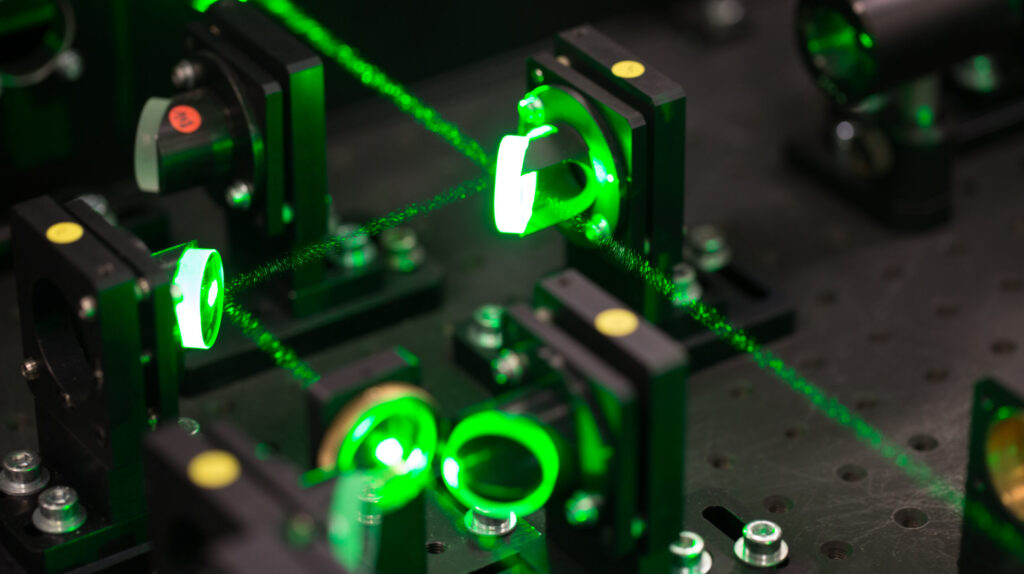
The Photonics Department develops its expertise in the field of light-matter interaction in the propagating regime. This expertise encompasses ultrafast nonlinear optics in a variety of media, ranging from solids to gases and plasmas, using configurations from optical fibers to integrated optics, including nanophotonics and plasmonics.
Activities range from theoretical studies to experimental research, which plays a significant role, with particular attention paid to technological and application developments. This experimental research relies on the technical resources of EQUIPEX+ SMARTLIGHT for optical instrumentation and ARCEN-Carnot for fabrication and characterization in nanophotonics. The department also possesses strong theoretical and numerical modeling skills and is embracing the concepts and tools of artificial intelligence.
In total, the department comprises approximately sixty faculty members, researchers, engineers, technicians, doctoral students, and postdoctoral researchers.
Within the experimental platforms, various types of materials and structures are developed: special optical fibers composed of nonlinear glasses adapted for the mid-infrared (tellurites, chalcogenides); nonlinear and transparent planar waveguides (titanium dioxide, silicon nitride, tantalum oxide); and plasmonic tracks (gold).
A significant activity of the department concerns the study and development of new, compact, and efficient coherent or high-brightness light sources: frequency combs, pulsed fiber optic lasers, frequency conversion, supercontinuum, optical synthesis, and portable Q-switched lasers. Activities also focus on nanophotonic components for optical neuromorphic arrays.
Research themes
Plasmonics, Resonant nanophotonIcs and SubMicron optics (PRISM)
The PRISM research team focuses on the electromagnetic phenomena involved in matter when it is structured at the sub-wavelength scale; photonic crystals, plasmonic devices, and metamaterials are key research areas for the group:
– electro-plasmonic devices,
– nonlinear plasmonics,
– quantum plasmonics,
– innovative materials for integrated nonlinear photonics.
- G. Colas des Francs, J.-C. Weeber, B. Cluzel (PR UBE)
- A. Coillet, K. Hammani, L. Salomon, C. Strutynski (MCF)
- A. Bouhelier, E. Dujardin (DR CNRS), F. De Fornel (DR CNRS émérite)
- F. Dell’Ova (IR CNRS)
- J. Arocas (IE CNRS)
Benoit.Cluzel@ube.fr
Tél. +33 3 80 39 60 10
Gerard.Colas-des-francs@ube.fr
Tél. +33 3 80 39 90 67
Femtosecond Processes and Intense Lasers (PFL)
Since 1999, the PFL team has been exploring the generation and control of molecular dynamics, making significant contributions to a scientific field now pursued by numerous international groups. It is distinguished by its all-optical approaches and innovative control strategies based on feedback loops using genetic algorithms:
– all-optical measurement of molecular alignment,
– two-dimensional alignment of linear molecules,
– control and optimization via shaped pulses,
– 3D alignment of asymmetric molecules with elliptically polarized pulses,
– observation of the high-order Kerr effect and its impact on ultrashort pulses,
– control strategies for planar alignment.
- O. Faucher (PR UBE)
- F. Chaussard, E. Hertz (MCF)
- P. Béjot (CR CNRS)
- F. Billard (IR CNRS)
Olivier.Faucher@ube.fr
Tél. +33 3 80 39 59 84
Solitons, Lasers, Fibers and Infrared Photonics (SAFIR)
The SAFIR team brings together theorists and experimentalists in nonlinear optics to develop advanced optical functions that harness light in various media. It combines nonlinear optics, ultrafast optics, optoelectronics, optomechanics, and innovative photonic materials to propose original approaches to optical signal processing.
Its projects include high-speed fiber sources, advanced optical functions, broadband infrared sources, and the study of localized wave structures such as solitons. In lasers, it develops innovative sources for industrial prototypes (portable LIBS) and explores the mid-infrared (2-20 µm) for applications in chemistry, biology, medicine, and the environment. The team also works on integrated nano-optical devices compatible with silicon technology.
- C. Finot, P. Grelu, G. Millot, O. Musset, F. Smektala, P. Tchofo-Dinda (PR UBE)
- C-H. Brachais, A. Coillet, K. Hammani, J.-C. Jules, P. Mathey, S. Salaün (MCF)
- B. Kibler, A. Picozzi (DR CNRS)
- P. Colman, E. Lucas (CR CNRS)
- J. Fatome, G. Gadret (IR CNRS)
- F. Desevedavy (IGR)
- C. Aquilina (AI UBE)
Bertrand.Kibler@ube.fr
Tél. +33 3 80 39 59 32
Frederic.Smektala@ube.fr
Tél. +33 3 80 39 60 29