



ICB – Laboratoire interdisciplinaire Carnot de Bourgogne

Nanosciences

Synthesis and characterization of nanoparticles and nanostructures, AFM microscopy, single-molecule spectroscopy, biosensors, protein physics, biomedical applications

Acting at the nanoscale to understand the macroscopic

The Nanosciences Department aims to access and act at the nanoscale in order to target, detect, model, and understand the underlying mechanisms that drive macroscopic responses.

To this end, it designs and invents inorganic and/or biological nanomaterials capable of responding at the nanoscale to external stimuli (electrical, magnetic, optical, chemical), as well as highly sensitive nanosensors and nanocharacterization tools. These innovations are essential for solving numerous societal problems in the fields of health, the environment, and agri-food.

The department brings together around twenty physicists, chemists, and biologists and collaborates with industry, healthcare institutions, and national research organizations (University Hospitals, CGFL, INRAE, INSERM), as well as numerous regional academic partners (FEMTO-ST, ICMUB, Institut Agro Dijon) and international partners in the USA, Japan, and Europe.

The department, which is highly interdisciplinary, has expertise in chemistry, physical chemistry, physics, biophysics, biochemistry, materials science and numerical simulation.

Aymeric Leray DIRECTOR
Aymeric.Leray@ube.fr
Phone +33 3 80 39 59 04
Julien Boudon DEPUTY DIRECTOR
Julien.Boudon@ube.fr
Phone +33 3 80 39 59 42
Annual Report 2024 Download the department’s activity report in PDF format
Members Find the complete directory of the entire department
Publications Check out the department's latest scientific publications
Research topics

Development of functional nanoparticles

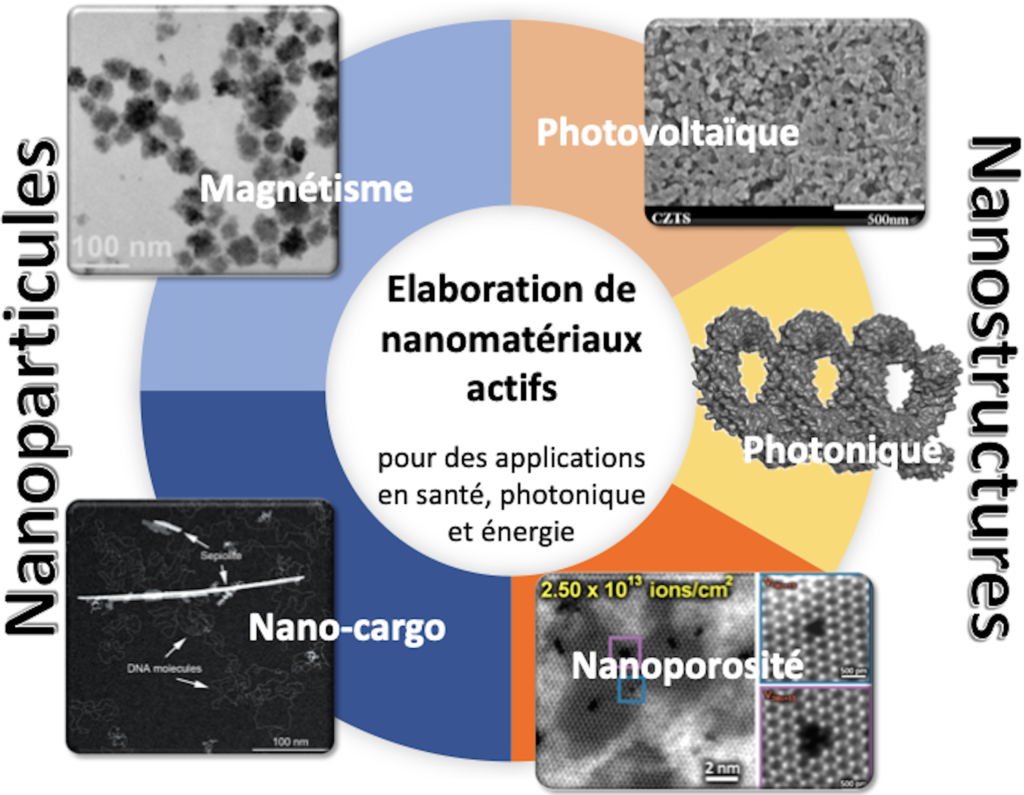
Superparamagnetic iron oxide nanoparticles (SPIONs) are developed and used for their interesting magnetic properties, making them suitable for applications such as tracers in magnetic resonance imaging (MRI) or for magnetically separating biological material. Within the nanoscience department, these nanoparticles (NPs) are functionalized with biocompatible molecules for various biomedical applications.

– To combat neurodegenerative diseases;
– To target extracellular vesicles.

Julien.Boudon@ube.fr
Phone: +33 3 80 39 59 42
Thomas.Girardet@ube.fr
Phone: +33 3 80 39 61 75
Nadine.Millot@ube.fr
Phone: +33 6 29 92 38 91

Development of plasmonic/optical/fluidic nanosensors

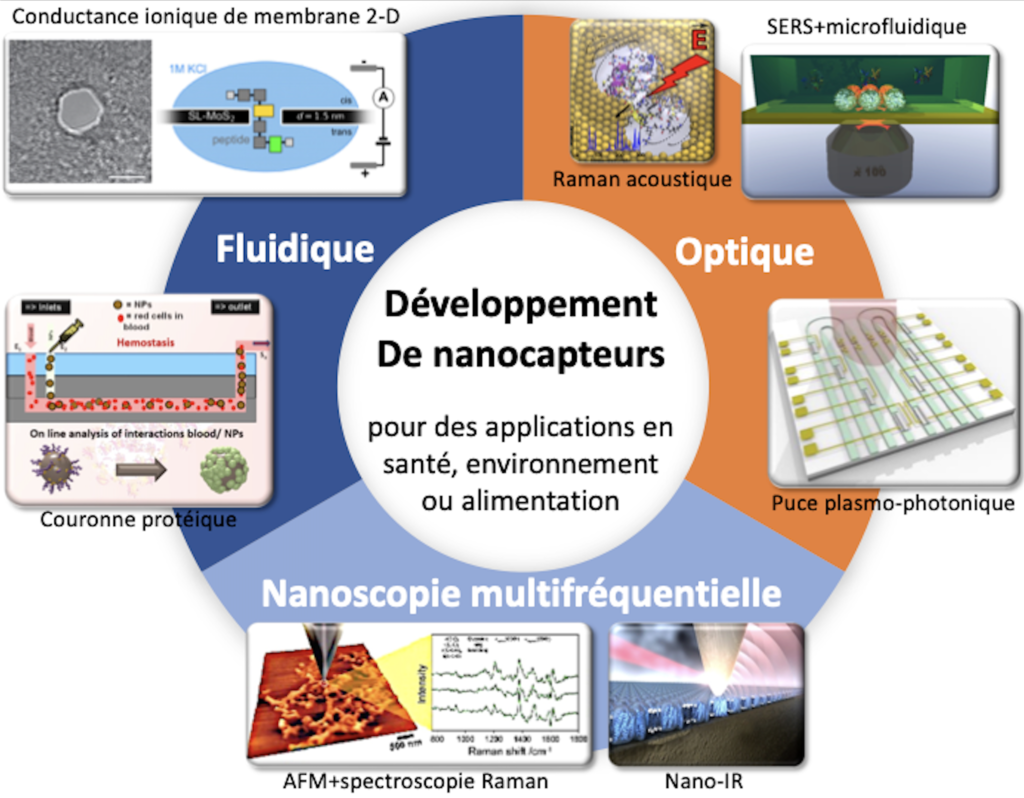
– Microfluidic optical chips for healthcare and the food industry: We develop prototypes of on-chip biosensors combined with microfluidic modules that we design and manufacture. These are used for diagnostic applications in the fields of food safety and healthcare.

– Plasmonic/optical nanosensors for protein conformation characterization: Neurodegenerative diseases can be identified from molecular markers (proteins), and the detection and characterization of the structures of these biological molecules requires the development of sensors at the single-molecule level. Characterizing these intrinsically disordered proteins is a significant challenge from both a theoretical and experimental perspective.

– For protein sequencing: Rapid disease diagnosis is a major public health issue. Many pathologies can be identified from molecular markers (proteins) present in physiological fluids (blood, saliva, etc.). In order to extract the amino acid sequence passing through a nanopore drilled in a 2-D MoS2 membrane and thus identify the disease marker protein, atomic-scale modeling of the nanosensor and molecular dynamics simulation, coupled with time series analysis and information extraction techniques and Machine Learning are used.

Laurent.Markey@ube.fr
Phone: +33 3 80 39 68 36
Aymeric.Leray@ube.fr
Phone: +33 3 80 39 59 04
Adrien.Nicolai@ube.fr
Phone: +33 3 80 39 60 93

Development of functional nanostructures

Nanostructures for photovoltaics, obtained using a low-cost and optimized liquid-phase process, will enable the fully ecological, non-toxic, and economical development of these devices over the next five years.

– Nanosources and nanoassemblies for photonics and plasmonics, based on perovskites in the form of crystalline nanoplatelets, nanocubes, or nanorods, are being developed. A correlation exists between the orientation of the faces and that of the emission dipole, establishing the link between morphology, structure, and emission anisotropy, and paving the way for luminescence engineering of these objects.

Nanoparticles and nanorods are being synthesized and used, or combined with other nanoparticles, as sensitive sensors for biological molecules due to their plasmonic properties.

Denis.Chaumont@ube.fr
Phone: +33  80 39 59 08
Lucien.Saviot@ube.fr
Phone: +33 3 80 39 61 42

Development of multifrequency characterization tools at the nanoscale

– Biological protein/membrane interactions: To elucidate, from a fundamental perspective, the interaction mechanisms between Lo18 stress proteins (small HSPs) and the biological membrane at the atomic scale, we use AFM-type nanoprobes capable of mapping systems both topographically and spectrally (IR, Raman, microwave).

– Non-destructive testing for component analysis: Since 2015, the Nanosciences department and the company ARDPI, members of the joint public/private laboratory NanoSense Lab, have been developing a unique and innovative solution in the world of non-destructive testing, based on scanning microwave microscopy (SMM). This technique enables 2D and 3D tomography of materials with nanometer resolution and high sensitivity.

– For the pharmaceutical industry: the goal is to achieve realistic comparisons between experimental and numerical assays, both at the particle level and at the level of a representative elementary volume of the tablet. Developing a “digital twin” modeling tool would be a significant advantage for the competitiveness of pharmaceutical tablet manufacturers, within the current economic and societal context of the relocation of healthcare product manufacturing activities to our regions.

– For the study of the assembly and remodeling of nucleoprotein complexes: we are developing new molecular imaging tools to gain a dynamic view of several steps in the mechanisms of homologous recombination (HR) and non-homologous fusion (NHEJ).

Eric.Finot@ube.fr
Phone: +33 3 80 39 37 74
Eric.Lesniewska@ube.fr
Phone: +33 3 80 39 60 34

Development, characterization and modeling of biological molecules

Understanding biological mechanisms at the atomic structure level of proteins is essential for the design of new therapies. Within the Nanoscience Department, we develop interdisciplinary approaches that bring together biochemists and physicists to simulate the dynamic behavior of proteins of interest and to synthesize and solve the structures of these biological nano-objects.

Several applications are envisioned:

– For the in silico design of proteins (enzymes) with novel and/or optimized catalytic properties.

– For the characterization of intrinsically disordered proteins involved in diseases (Parkinson’s, Alzheimer’s, cancer) and for the design of biopharmaceuticals.

– To study the role and function of proteins in the oral cavity involved in flavor perception (encompassing taste, smell, and trigeminal sensations) in humans, as well as their equivalents in different animal species.

Skip to content