In parallel with the experimental work associated with each research theme of the PMDM department, we are developing a process and/or procedure modeling approach to improve the control of properties as a function of microstructure.
The range of methods is very broad.
At the macroscopic scale:
– Finite element method for a multiphysics approach and a description of mechanical behavior (ANSYS, Fluent, COMSOL multiphysics, Abaqus, etc.)
At the microscopic scale:
– Molecular dynamics (EAM potential method for metal interactions, ReaxFF for oxidation reactions, etc.)
At the mesoscopic scale:
– Discrete Element Method (LIGGHTS); – Smoothed Particle Hydrodynamics
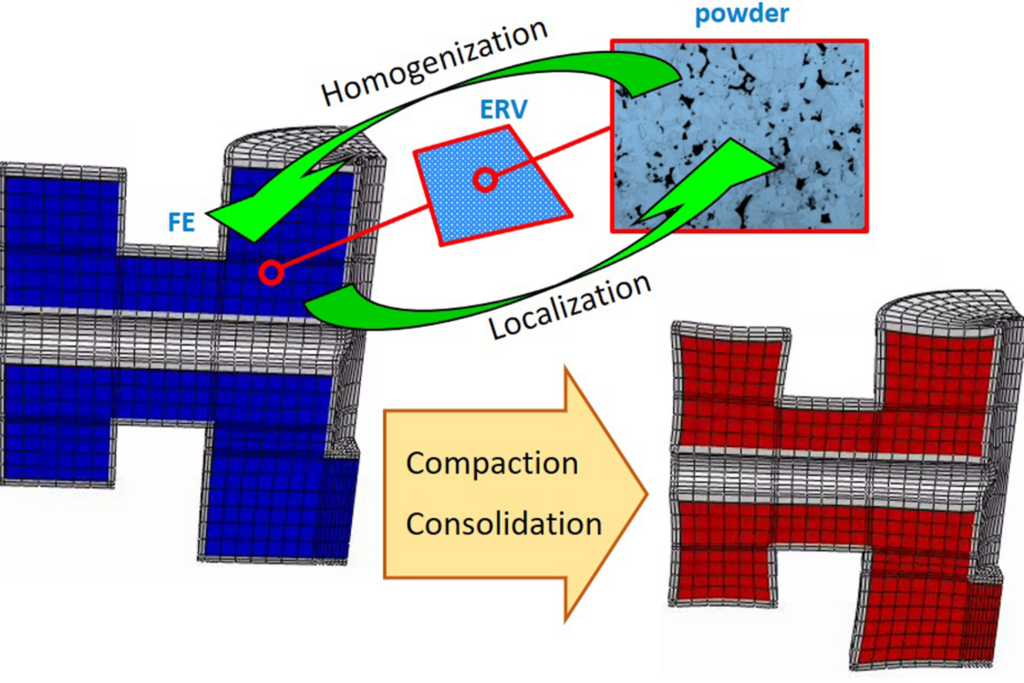
Using finite element techniques, we model the deformation mechanisms that occur during powder compaction under high pressure. The goal is to design container shapes that will produce parts as close as possible to the desired shape by hot isostatic compression (HIC) and achieve optimal consolidation at every point. This requires establishing constitutive laws for a finite element model (FEM) of the powdered material to accurately describe the scaling transition. Calculating local stresses and temperatures allows us to describe the microstructural changes occurring in the powder during compaction.
Estimation of effective material properties from micrographs
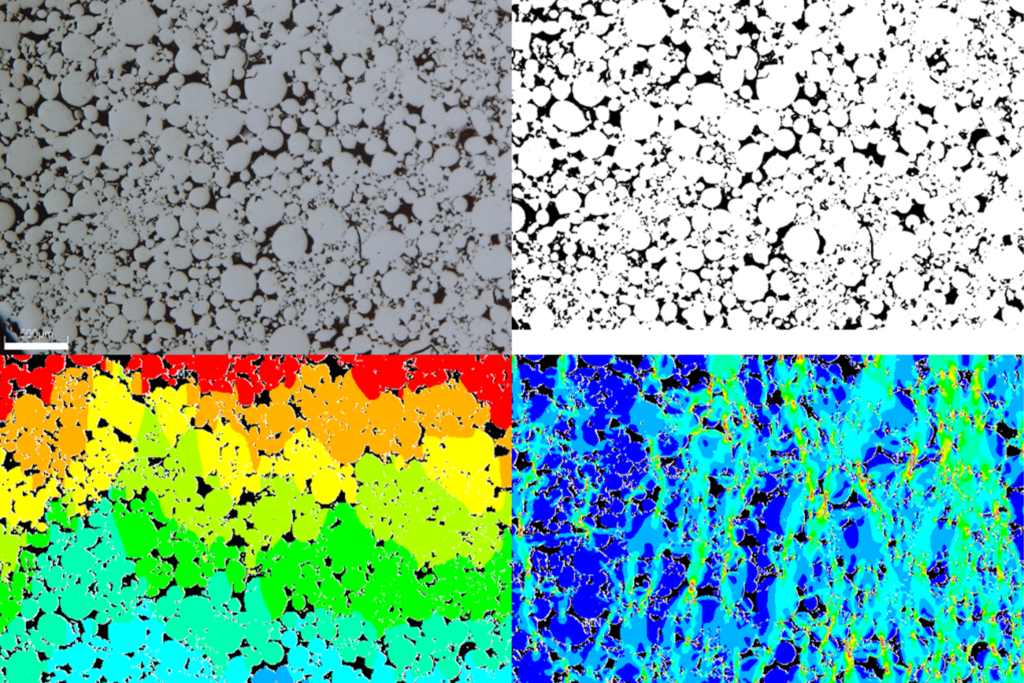
In this type of calculation, the image of the structure itself constitutes the mesh: each pixel is converted into a square element for finite element modeling, which is then processed by the ANSYS code.
A partially sintered stainless steel powder (top left) and its corresponding binary image (top right). A vertical displacement field obtained for a virtual vertical compression load (bottom left) and the corresponding stress field (Von Mises stress) (bottom right).
The model allows, for example, the evaluation of the ratio between the elastic modulus of the partially sintered material and the elastic modulus of a dense material of the same type.
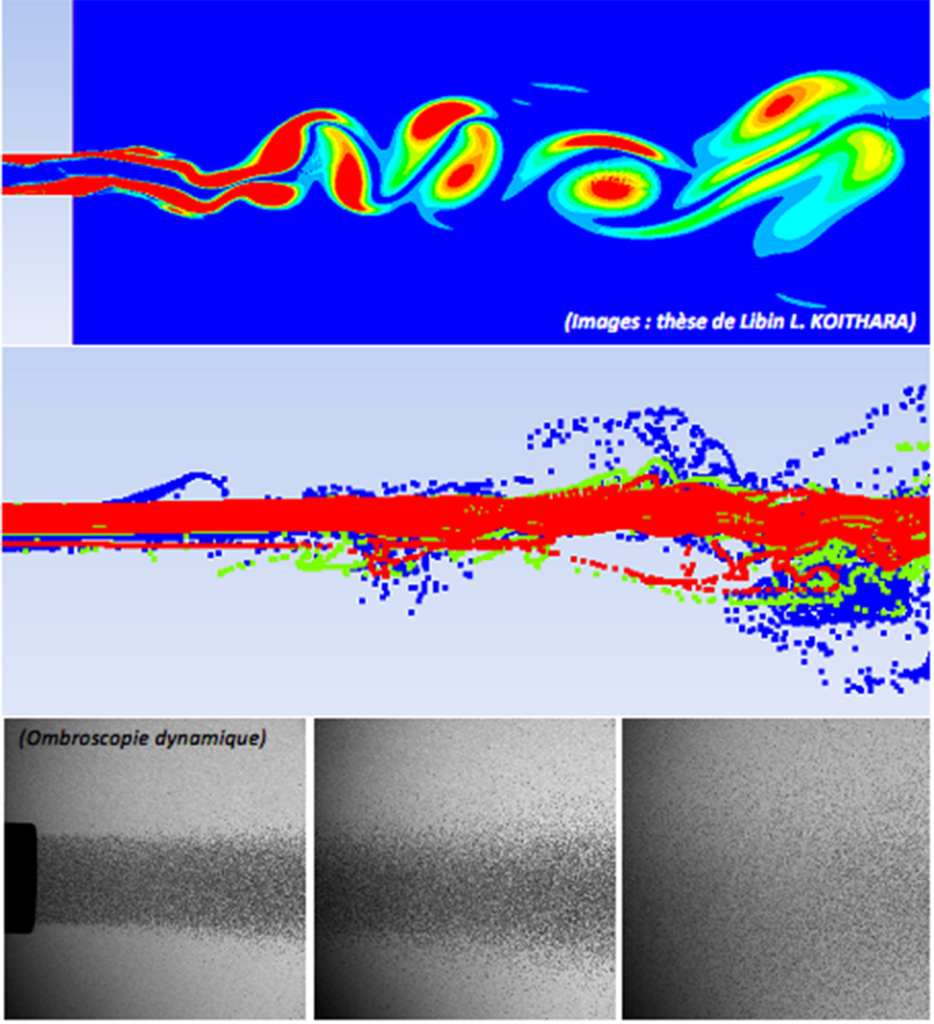
Understanding, controlling, and predicting the phenomenological behavior of cold spray additive manufacturing enables the continuous development of several technological solutions capable of integrating innovative materials and their performance. The PMDM team at the UTBM site is working on this issue by leveraging modeling and numerical simulation to optimize the operation of this additive method by mastering all the interactions between process parameters and additive material growth during the continuous collision of micrometric powders on a target substrate. The simulation work thus encompasses three distinct but closely related aspects: controlling the material growth kinetics as a function of the movement and trajectory of the spray nozzle; the phenomenological behavior of the supersonic compressible flow inside and outside the nozzle and its kinematic and thermal interactions with the micrometric powders; and the coating formation mechanisms produced by ballistic collision and high deformation rates when these prevail, as in the case of deformable materials. The “process simulation” theme thus develops predictive multiphysics models which serve to characterize the phenomena governing additive manufacturing by thermal spraying and their consequences on the responses of the material studied during the formation of the deposit.
Interface reactions in metallic nanometer multilayers
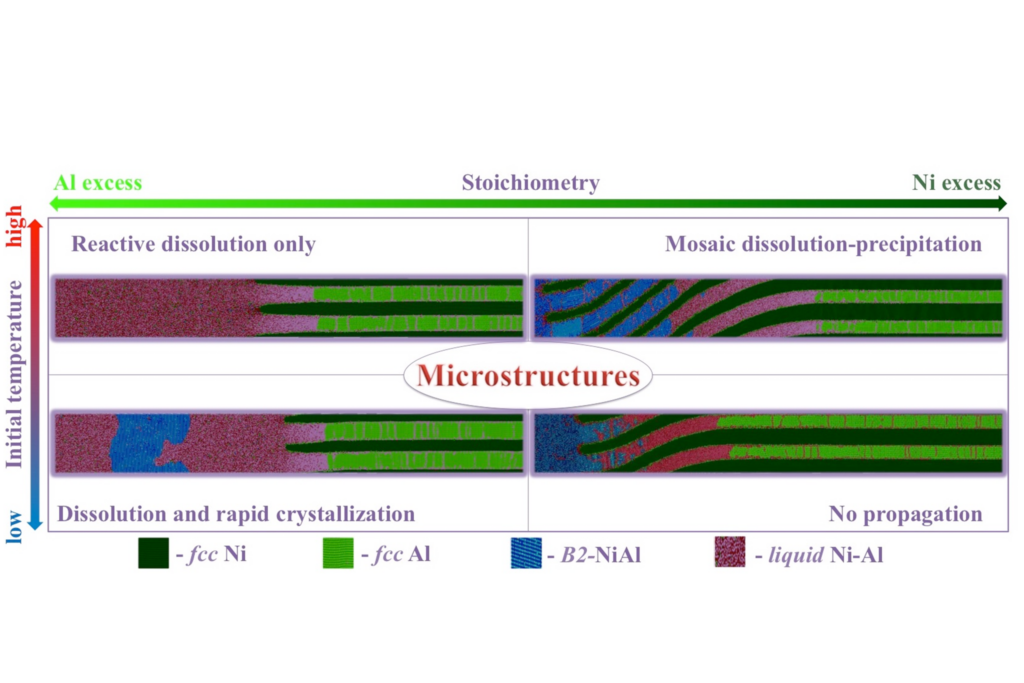
We study the self-sustaining reactions that develop in nanometric metallic multilayers using microscopic modeling. Molecular dynamics allows us to identify the elementary mechanisms associated with mass and heat transfer, dissolution and mixing, and phase transitions at the nanoscale. This modeling aims to understand the relationship between the microstructure and the properties of the reagent front. These high-energy materials are used in welding processes for temperature-sensitive materials.
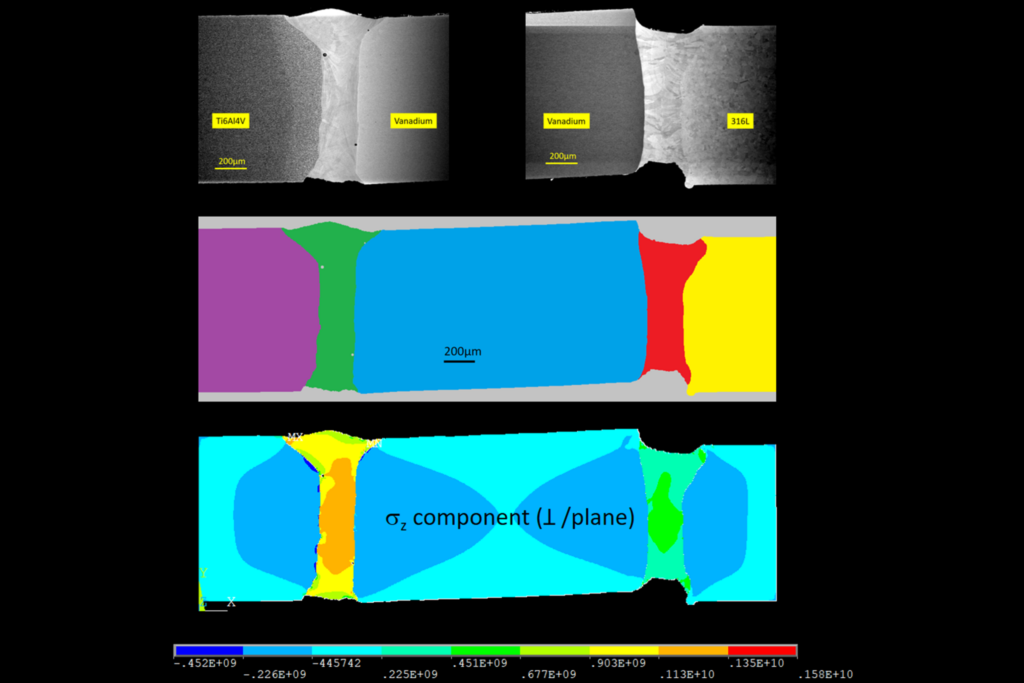
Estimation of stress fields in welded assemblies, based on calculations using micrographs
For this type of calculation, the micrograph image of the assembly (after processing) serves as the mesh for the finite element analysis (FEA).
The case presented concerns a Ti6Al4V/stainless steel assembly produced using a vanadium insert. This insert prevents the formation of brittle phases (notably FeTi and Fe2Ti) generally observed in direct welding. However, this assembly requires the creation of two separate weld beads. The micrographs of the two individual beads are shown at the top. The five-material assembly used for the calculations (each color corresponds to a different material) is shown in the middle image. Finally, the sigma_z (Pa) component of the stress tensor (component perpendicular to the cross-section) illustrates the results obtained by considering the thermal contraction of the materials in the two beads during their cooling to room temperature. The results indicate the presence of tensile stress (+) in both welds, balanced by compressive stress (-) in the unfused base materials. It should be noted, however, that the stress level remains sensitive to the constitutive law considered for the materials (here, bilinear laws). In particular, the consideration of a yield strength of 1 GPa for TA6V (and for the TA6V/vanadium weld) explains the presence of a stress level as high as 1.2 GPa in the weld in question.