

ICB – Laboratoire interdisciplinaire Carnot de Bourgogne

Chemical Analysis Center

Presentation

The Chemical Analysis Center (CAC) is part of the INTERFACES Department of the ICB laboratory. The CAC’s equipment is detailed below.

This service performs physicochemical analyses (conductivity, pH measurement, etc.) as well as elemental analyses of solutions or solids after dissolution. Most elements of the periodic table are covered across a wide range of concentrations, including trace amounts (very low concentrations).

The service also provides advice and training to users on sample preparation, instrument operation, and the optimization of methods/protocols for the systems being analyzed.

The CAC thus offers a range of services to the scientific community and industry for their analytical needs.

Anne-charlotte.guillet RESPONSABLE TECHNIQUE
Christophe Labbez RESPONSABLE SCIENTIFIQUE
Christophe.Labbez@u-bourgogne.fr
Tél. +33 3 80 39 61 76
Demande d'analyse Contacter le CAC
Analytical equipment

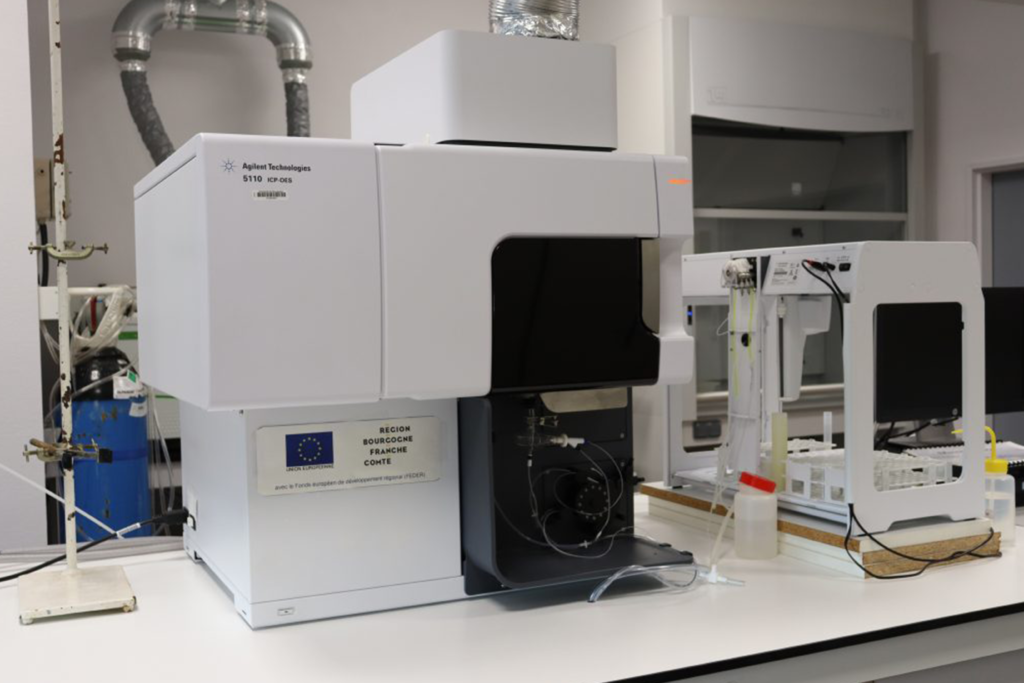
ICP-OES 5110 AGILENT TECHNOLOGIES

Inductively coupled plasma optical emission spectrometry (ICP-OS) allows the analysis of several major elements present in solution.

Link to the periodic table

Principle: The principle of this technique is based on the ionization of microdroplets of samples in an argon plasma (6000-8000°C). The plasma acts as an energy source to dissociate, excite, and ionize the sample. When the atom is excited, an electron changes orbitals, then the atom de-excites, and the electron returns to its ground state, emitting a photon characterized by a wavelength specific to the element. The emitted photon is then detected by a CCD detector. The signal intensity is proportional to the concentration of the element being analyzed.

Detection limits: up to 200 ppb, determination of the limit of detection (LOD) depending on the matrices and samples to be analyzed.

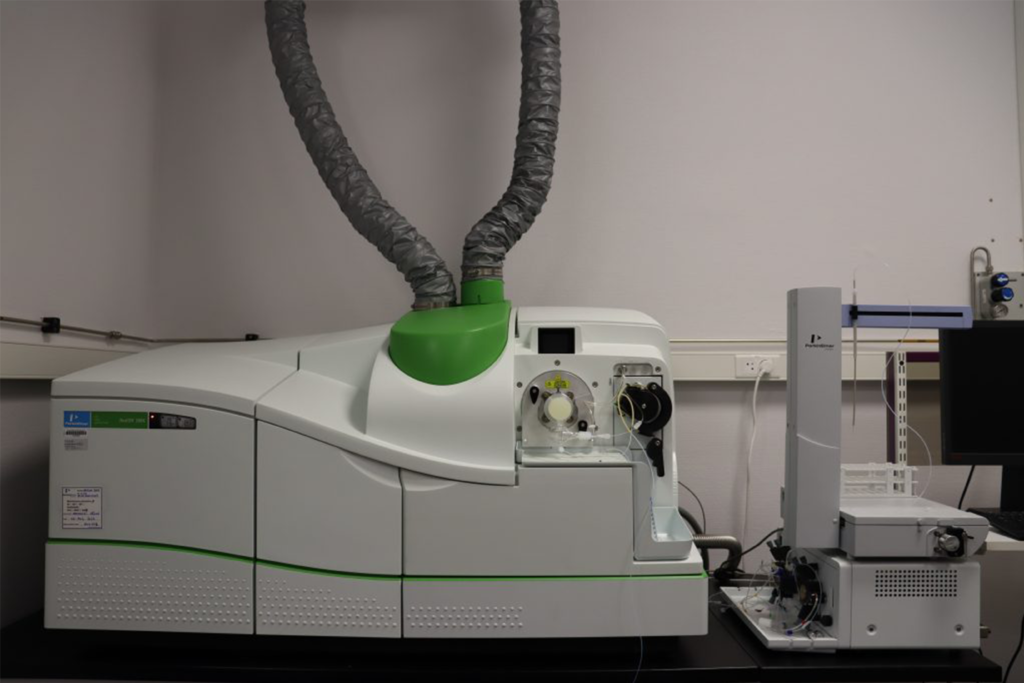
ICP-MS NexION 300X PERKINELMER

Plasma mass spectrometry (PMS) allows for the quantification of elements by measuring the mass-to-charge ratio of atoms within a material.

Link to the periodic table

Principle: This technique is based on the ionization of microdroplets of samples in an argon plasma (6000-8000°C). The plasma acts as an energy source to dissociate, excite, and ionize the sample. The atoms, typically ionized once, are then separated in the mass filtering system. This system consists of metal rods to which potentials are applied. Elements are detected based on their mass and charge.

Detection limitations: Up to the point of detection (PPT), the limit of detection (LOD) is determined based on the matrices and samples being analyzed.

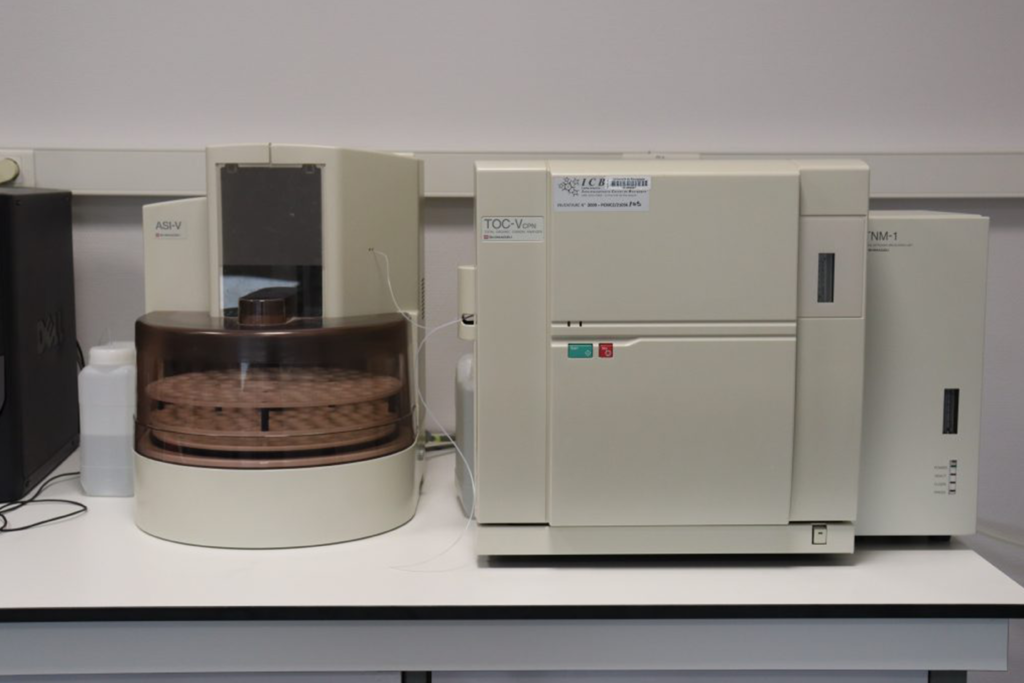
SHIMADZU TOC-VCPN Total Organic Carbon Analyzer

The organic carbon analyzer allows for the analysis of natural water and industrial effluents. This instrument can measure total carbon (TC), inorganic carbon (IC), total organic carbon (TOC), and nitrogen (TN).

Principle for carbon analysis: The sample is injected into a quartz tube containing a platinum catalyst. The carbon is converted to CO2 by combustion at 680°C within the platinum catalyst. The CO2 produced is then transported by a carrier gas (air) to the Non-Dispersive Infrared (NDIR) detector. The NDIR emits an analog detection signal that forms a peak. The peak area is measured. The peak area is proportional to the TC concentration in the sample.

Principle for nitrogen analysis: The sample is injected into a combustion tube (furnace at 720°C). The TN in the sample decomposes into nitric oxide. The gas then enters a chemiluminescent gas analyzer, where nitric oxide is detected. The detection signal from the chemiluminescent gas analyzer generates a peak, and the concentration of TN in the sample is measured.

In TN analysis, the state (crystalline state) in which the TN exists in the sample affects the TN detection rate. Nitrogen from nitrates, nitrites, ammonia, and most other organic nitrogen compounds exhibits high detection rates. In contrast, some organic nitrogen compounds (such as hydrazines, pyrazolones, and nitrogen compounds) have detection rates ranging from 10% to 60%, depending on the concentration.

Detection limits: 50 ppb in TC, 4 ppb in IC, and 0.03 ppm in N

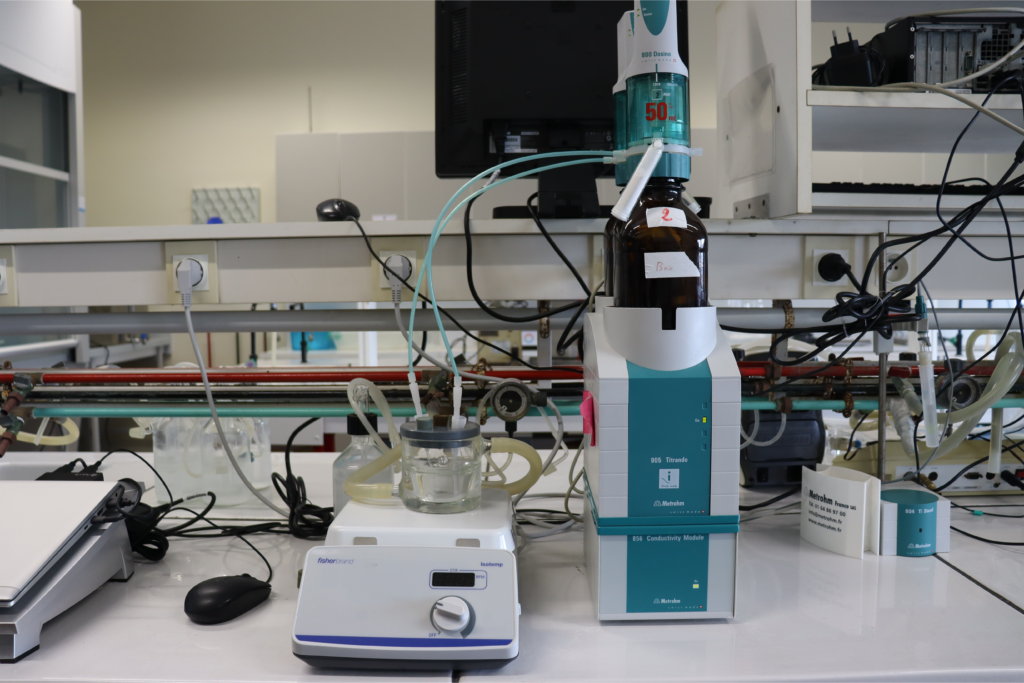
Titrantor 905 Titrando and 856 Conductivity Module METROHM

Principle: The 905 Titrando titrator allows for various potentiometric titrations with diverse matrices. The 856 conductivity module can be coupled to the titrator. It allows for the measurement of the conductivity and temperature of the analyzed solution.

Skip to content